
Novated Leases for Small Businesses Grow in 2023

About the study

Australia’s competitive labour market is motivating employers to actively seek out new ways to retain current employees while attracting new candidates. Novated leases are an employee perk that has seen significant growth in 2023.

A novated lease is a three-way agreement whereby an employer, employee and novated lease provider agree to a novated lease, a form of car finance. It enables employees to salary package a vehicle, with the lease payments and running costs (including fuel, servicing and insurance) paid from their pre-tax pay. When the lease ends, the employee can pay the balance to own the car or switch to a new car and only pay the difference.,

Metro commissioned a survey of an independent panel of 204 Australian business directors and decision-makers to explore business attitudes about novated leases as an employee attraction and retention tool. Metro also aimed to find out the businesses’ understanding of novated leases by asking them to select a statement they believe best describes a novated lease.

The survey spanned the full spectrum of SME owners. They included micro (1-15 employees), small (16-50 employees, medium (15-200), and large-sized businesses (more than 200 employees).

The survey respondents matched the geographical and population spread of the Australian population.

Metro also analysed its own novated lease settlement data between October 2022 and November 2023 to gauge the growth in this type of car financing in the last year.

Added to the analysis was Metro’s ranking, with percentage growth figures, of the vehicle brands that are most popular among businesses in novated lease arrangements.


Growth in novated leases in 2023

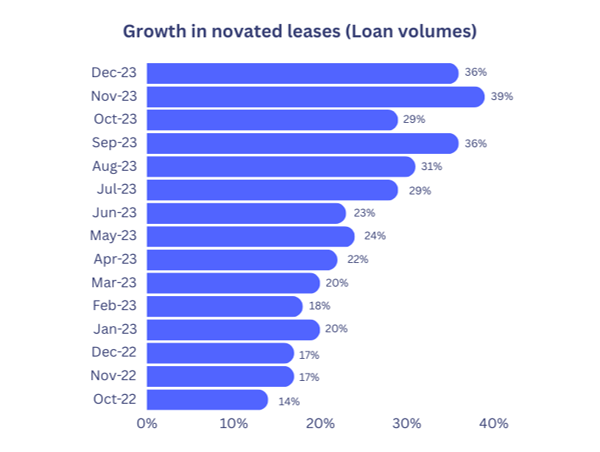
Metro’s own data reveals that novated leases are growing  in popularity despite being a recent addition to its service offerings. From October 2022 to November 2023, Metro reported a , with novated leases making up more than a quarter (26%) of all Metro car loan settlements.

Novated lease settlements as a percentage of all car loan/lease settlements grew from 16 per cent in October 2022 to 31 per cent in October 2023 (15% YOY increase). The proportion of novated leases reached a peak of 31 per cent in the 2023 September quarter – a 14.4 per cent increase from the 2022 December quarter.

September 2023 saw the highest proportion of novated lease settlements, peaking at 35 per cent, followed by 31 per cent in October and August 2023.

The proportion of novated leases by lease volumes (amount financed) peaked in the September 2023 quarter, hitting 32 per cent – up from 16 per cent in the December 2022 quarter. September 2023 saw the biggest novated lease volumes at Metro, at 36 per cent.

growth in novated lease chart


Novated leases for electric vehicles see the biggest growth

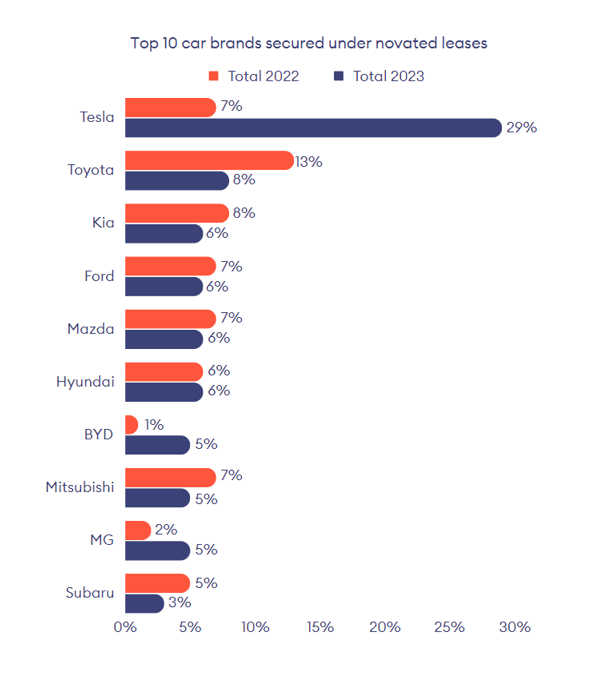
Metro also analysed the brands that are most popular for novated lease arrangements in 2022 and 2023, comparing active loans across the two years. Thanks to Federal and State Government incentives for electric vehicle purchases, Tesla is leading the charge, with Metro reporting a 22 per cent increase in Teslas financed under novated leases in 2023.

BYD and MG, also well-known for electric cars, experienced a 4 per cent and 3 per cent growth this year for novated leases, respectively.

Novated leases under Kia, Mitsubishi and Subaru also declined by 2 per cent, while novated leases for Hyundai vehicles remained the same, at 6 per cent.

Ford and Mazda experienced a 1 per cent decrease in active novated leases from 2022.
novated lease chart - top 10 cars


Business sentiment on novated leases helping them retain and attract employees

The increase of novated leases over the past year is only projected to rise with more companies predicted to acquire employee perks and take advantage of government incentives into creating an economy and environment that fosters the growth of electric vehicles.

In its survey of 204 Australian business directors and decision-makers, Metro sought to discover how many businesses believe that offering employees or new candidates novated leases through a salary sacrifice arrangement would help attract new talent and retain existing employees.

Respondents could select from one of the answers below:

  1. Yes, I think a novated lease would help to retain some existing employees
  2. Yes, I think a novated lease would help to attract new employees
  3. No

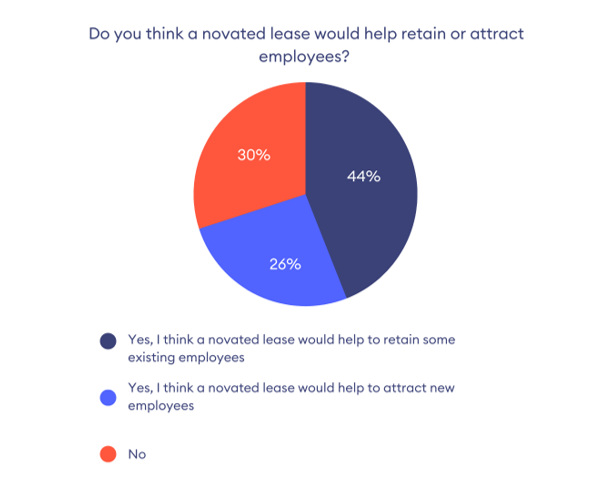
The data revealed 70 per cent of businesses believe a novated lease would help staff retention alongside attracting new candidates, while only 30 per cent stated otherwise.

More specifically, 44 per cent of businesses believe that a novated lease would help to retain

novated-lease-attracts

some existing employees, while a quarter (26%) believe that a novated lease would help attract new candidates.

By State.

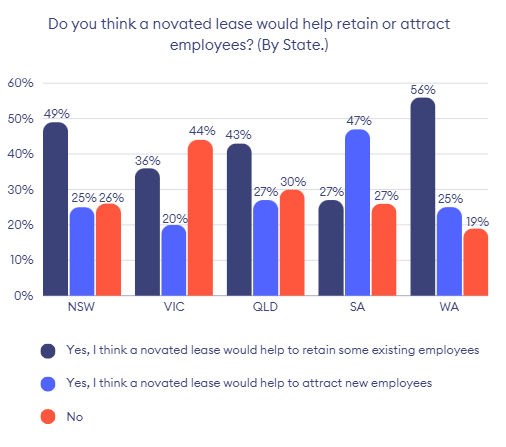
Metro found West Australian businesses have the greatest confidence in novated leases to help with staff retention and attract new employees, with 81 per cent stating so. This is followed by:

  • 74% of NSW businesses
  • 74% of South Australian businesses
  • 70% of Queensland businesses
  • 56% of Victorian businesses

More specifically, 56 per cent of WA businesses believe that a novated lease would help retain employees and a quarter (25%) believe it would help attract new candidates.

The data also revealed that businesses in SA are more likely to believe a novated lease would entice new employees (chosen by 47%).
novated lease chart


By business size.

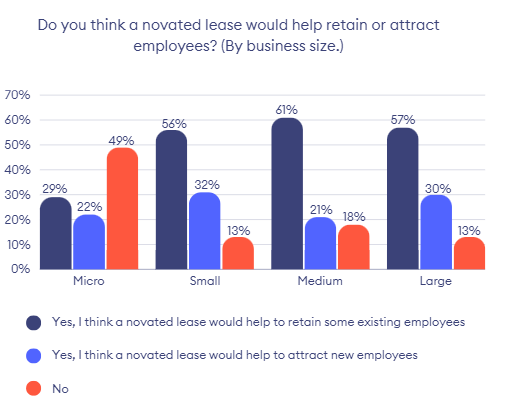
The data reveals that small (11-50 employees) and large enterprises (more than 200 employees) are equally likely to believe that a novated lease would either assist in attracting new staff or retain current employees, with . This is followed by 82 per cent of medium-sized businesses and only 51 per cent of micro businesses.

Specifically, medium-sized businesses are most likely to believe that novated leasing would help with staff retention (chosen by 61%), followed by 57 per cent of large businesses and 56 per cent of small businesses.
novated lease chart

However, despite the increasing popularity of novated leases and the benefits businesses believe it has on staff retention and recruitment, the survey also found that businesses still need more education around novated lease arrangements.


More than half of businesses don’t understand novated leases

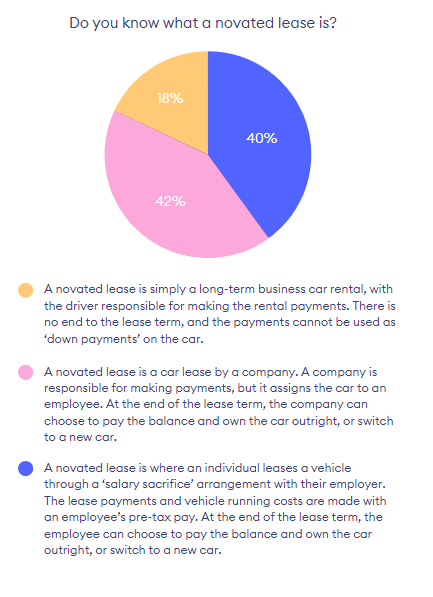
Metro sought to find out how many Australian businesses understand what a novated lease is. Metro asked respondents to choose the answer they believe best describes a novated lease, from the options below. The last option is the only true answer:

  1. A novated lease is simply a long-term business car rental, with the driver responsible for making the rental payments. There is no end to the lease term, and the payments cannot be used as ‘down payments’ on the car.
  2. A novated lease is a car lease by a company. A company is responsible for making payments, but it assigns the car to an employee. At the end of the lease term, the company can choose to pay the balance and own the car outright, or switch to a new car.
  3. A novated lease is where an individual leases a vehicle through a ‘salary sacrifice’ arrangement with their employer. The lease payments and vehicle running costs are made with an employee’s pre-tax pay. At the end of the lease term, the employee can choose to pay the balance and own the car outright, or switch to a new car.

Only 40 per cent of respondents chose the correct (c) answer, leaving 60 per cent of businesses with a false or inaccurate understanding of the increasingly popular employee perk.
novated lease pie chart


By State.

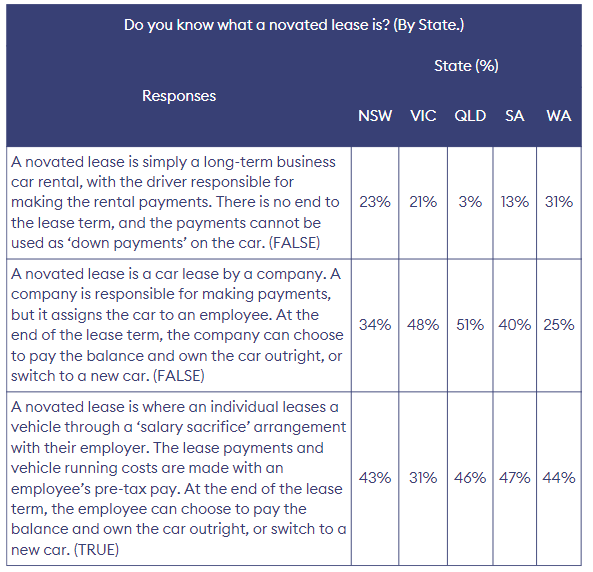
Across the states, Metro found that businesses in South Australia are most likely to have an accurate understanding of novated leasing, with 47 per cent selecting the correct answer. This was followed closely by businesses in Queensland (46%), Western Australia (44%) and NSW (43%). Victorian businesses are least likely to know what a novated lease is, with only 31 per cent selecting the right answer.

The data further reveals that over half (51%) of businesses in Queensland and 48 per cent of Victorian businesses believe that a novated lease is a car lease by a company whereby the company is responsible for making payments whilst assigning the car to an employee (answer B).
novated lease by state


By business size.

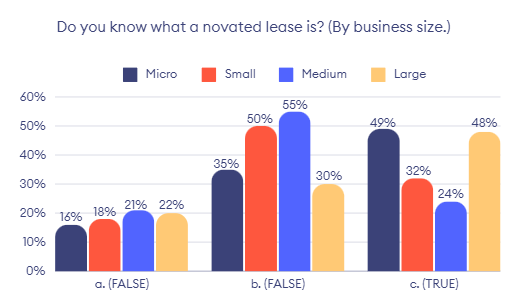
Metro found that medium-sized businesses are least likely to have a correct understanding of novated leasing, with 76 per cent selecting incorrect answers (A & B).

Micro businesses are most likely to select the correct answer, with nearly half (49%) selecting answer C. This was followed by 48 per cent of large businesses, 32 per cent of small businesses, and less than a quarter (24%) of medium-sized businesses.

More than half (55%) of medium-sized businesses and half (50%) of small businesses are under the misconception that novated leases involve the company making payments towards the lease after assigning it to an employee (answer B).
novated lease chart

Lower levels of understanding around novated leases may also lead to a small proportion of businesses being aware that they can benefit from government-backed electric vehicle subsidies, which offers thousands of dollars in rebates, fringe benefits tax, and stamp duty exemptions.

For example, zero-emission vehicles owned by Victorian residents don’t attract luxury vehicle stamp duty rates, rather they pay a flat rate of $8.40 of market value, regardless of the purchase price of the vehicle. Residents in Western Australia can also score a $3500 rebate on new zero-emission vehicles with a dutiable worth of $70,000.

On the road: Around the country for incentives for buying electric vehicles

Federally:

  • Battery electric vehicles, plug-in electric vehicles don’t pay customs duties as long as they’re below the luxury car tax threshold.
  • Zero or low tailpipe emission vehicles below the luxury car tax threshold are exempt from Fringe Benefits when financed under a novated lease. This places EVs more in reach of employees who wish to take out a novated lease.

NSW:

  • New and used EVs cheaper than $78,000 do not attract stamp duty.
  • The government’s $3,000 rebate for EVs ends on 31 December, 2023, from when it will invest more in EV charging infrastructure.

Victoria:

  • Zero-emission vehicles don’t attract luxury vehicle stamp duty rates, rather they pay a flat rate of $8.40 of market value, but that is regardless of the purchase price paid.
  • As well, zero and low-emission vehicles can get a $100 discount on annual vehicle registration, but this isn’t available for electric heavy vehicles nor electric motorcycles.

Queensland:

  • There is a $6,000 rebate for individual buyers of new electric vehicles, and up to a $3,000 rebate for businesses. The purchase price threshold is $68,000.
  • Sales of electric and hybrid vehicles save 33% on stamp duty. Find out more here.

South Australia:

  • A limited number of $3,000 rebates and three years’ free registration are available for battery electric vehicles worth less than $68,750. Learn more about the program here.

Western Australia:

  • This state is offering a $3,500 rebate for the first 10,000 buyers of new zero-emission vehicles with a dutiable worth of $70,000. Read the fine detail here.

Tasmania:

  • Tasmania is in between offering incentives for electric vehicle buyers.

Northern Territory:

  • Up until 30 June 2027, a $1,500 stamp duty discount is on offer to those buying new or used electric vehicles, fuel-cell and plug-in hybrids. It’s limited to vehicles having a dutiable worth no more than $50,000.
  • Over that time frame, new and existing battery-electric and plug-in hybrid electric vehicles will enjoy concessions on registration and stamp duty. This applies to cars imported from interstate or overseas, previously registered or modified electric vehicles.
  • Businesses and homeowners are eligible for a $2,500 and $1,000 rebate respectively to purchase and install an electric vehicle charger.

Australian Capital Territory:

  • New and used zero-emission vehicles have two years’ free registration until June 30, 2024.
  • New cars, motorcycles, utility and light commercial vehicles that are zero-emission are stamp duty exempt.

https://www.mynrma.com.au/electric-vehicles/buying/ev-incentives

Loan Repayment Tips

Safeguarding your business finances: managing your business loan repayments effectively

With banks tightening of lending standards in today’s economic climate, are you looking for ways to
better manage your existing business loan repayments and business financing?
Securing a business loan empowers businesses to grow, hire staff, replace equipment, and expand
into new markets. While securing a business loan is a significant step towards growth, managing
your loan repayments effectively is essential to avoid financial pitfalls.
In this article, we share actionable tips and strategies to ensure that your business loans and
monthly expenses are managed in a cost-effective and efficient way.

1. Analyse your cash flow

When entering a commercial finance, business finance, or vehicle finance agreement, a crucial step
is to develop a comprehensive plan. Set aside money for monthly repayments and prioritise it in
your budget above less critical expenses. Unnecessary spending can lead to budget overruns,
potentially leaving you short of cash for essential bills and expenses. Keep a close eye on your typical
monthly transactions and expenses.
Additionally, to ensure a healthy cash flow, you could incorporate a profit and loss forecast to
project income, costs, and profits over the loan term. This forward-looking approach ensures your
business can confidently meet financial obligations, including loan repayments, throughout the loan
term, enhancing long-term financial stability.

2. Streamline your repayment schedules for efficiency

When managing business loans and monthly expenses, streamlining your repayment schedules can
lead to significant cost savings. Consider asking your broker to align the repayment dates with your
cash flow cycles, which can reduce financial strain.
Efficiency in your repayment strategy can help you make the most of your business financing while
ensuring your monthly expenses remain manageable.

3. Adjust your repayments based on actual revenue

Running a business can sometimes mean fluctuations in your incoming revenue, influenced by
various factors such as changes in market demand, economic conditions, competition, and internal
business operations.
Regularly review your cash flow to accommodate these fluctuations in revenue and unexpected
expenses. In slower months, you may want to consider reducing business expenses temporarily to
ensure you can make loan payments, or top-up on your repayments. When your revenue exceeds
expectations, it could be worthwhile allocating the surplus to loan repayments or reserve it for
future obligations.

4. Track your spending

Good record-keeping is another effective way to stay on top of your finances and repayments. It
enables you to make easy adjustments based your loan repayment strategy and priorities. You can
maintain separate business accounts, organise receipts, use spreadsheets or accounting software,
and consider working with an accountant if needed.
A valuable way to help you prioritise your records could be implementing a color-coded system:

  • Non-negotiable payments (red): These are top-priority expenses, such as loan repayments and
    staff salaries. Allocate funds for them in advance to avoid financial strain.
  • High-priority payments (yellow): These crucial but flexible expenses, like business travel and
    client meetings, should follow non-negotiable payments in your budget.
  • Lower-priority payments (green): Adjust expenses such as team outings and training, as they
    are less critical.

5. Maintain open communication with your broker

Building a lasting relationship with your broker is essential in the world of business lending. To foster
a strong, long-term partnership, be forthright, especially when dealing with streamline or no doc
loans.
Typically, when a small business owner or a self-employed individual needs access to finance, but
lacks the required documentation, then streamline or no doc business loans are ideal to gain access
to needed capital. These loans offer similar terms to regular business loans, but don´t require the
same number of financial statements, documents or other paperwork traditional loans require.
While low doc or no doc business loans may appear tempting to avoid mountains of paperwork, it’s
still important to thoroughly crunch the numbers, ensuring that you can comfortably meet your
repayment obligations. Additionally, conducting your own research to gather insights from other
brokers or lenders on alternative loan options is a wise step to make informed financial decisions.

6. Secure business finance wisely

Finally, when seeking business finance via any broker, ensure you secure a sound and beneficial
arrangement. Begin by defining your needs clearly and assessing your budget to determine what you
can comfortably allocate.
Next, shop around for multiple options, understand the terms and conditions, and consider potential
tax implications. Plan for contingencies and align the financing term with the expected lifespan of
the vehicle or equipment. Seek professional advice if needed. For example, with Metro, they can
easily tailor finance terms based on your needs, whether you are buying brand new or replacing an
existing asset.

Metro is an independent Australian non-bank lender specialising in auto and equipment finance for
businesses, car finance for consumers, and novated leasing. Excelling in customer service and offering highly
competitive rates, Metro (metrofin.com.au) is one of Australia’s most popular non-bank commercial asset
finance lenders. Feel free to speak with a Metro broker today to explore the available options for your
business.

Common Myths & Misconceptions On Novated Leases

Novated leases are a great way for individuals to lease – and eventually purchase – a car salary packaged
through their employer.

However, there are plenty of misconceptions and myths around novated leases, leaving many people asking, ‘Are they worth it?’ Whether you’re seeking a novated lease through your employer or are a business owner considering offering novated leases to your employees, there are plenty of benefits to signing a Novation Agreement.

Myth number 1: They are only available to businesses.

Novated leases are one of the most cost-saving car loans available to individuals. Many people falsely believe that novated leases are for business use only. In fact, they are an agreement between the employee and employer and can be used by other members of the employee’s family, as long as they are covered by insurance. Whether you’re looking for a new = or = second-hand car, novated leases are available for a wide variety of vehicles.

Myth number 2: It is expensive.

There is a common misconception that novated lease providers charge a premium for the cost of the car. This is incorrect. Consumers can access more competitive prices if securing a car through a fleet provider, who negotiate better deals thanks to their strong relationships with manufacturers as they purchase large numbers of vehicles each year. In addition, because the monthly repayments and running costs come out of the employee’s pre-tax dollars, the employee saves on these costs throughout the life of the lease.

Myth number 3: There is a lot of administrative work.

For businesses reluctant to offer novated leases to their employees because they think that it will cost them time in paperwork and administration, one of the best parts of a novated lease is that the agreement is managed by a third party. It is a simple and hassle-free process. Once a business sources a novated lease provider, they simply need to notify their employees that novated leasing is part of their salary package offering and ensure the payment is deducted from the employee’s salary.

Myth number 4: Only high-income earners will benefit.

There is a common misconception that only those who earn large salaries can benefit from a novated lease, but the truth is far from that.

Employees earning from around $60,000 to six-figure salaries who are interested in taking out a car loan can use a novated lease to help stretch out repayments and choose another vehicle at the end of the lease term or pay off the residual amount to purchase the vehicle outright.

Metro offers salary packagers and their clients a range of long-term novated leases, ranging from 12 to 60 months. Furthermore, employees can also salary package their registration, insurance, on-road costs, vehicle maintenance, and fuel card. Regardless of how little or how many kilometres they drive, there are plenty of benefits.

Is Australian SME Growth Hindered by Underinvestment?

About the study

METRO CAPITAL COSTS HINDER GROWTH PDF

Metro commissioned a survey of 200 business owners to find out if and why
businesses are being held back from acquiring capital assets that will help grow
their businesses further.

Metro surveyed business owners across the full SME spectrum: micro (1-15
employees), small (16-50 employees) and medium (51-200 employees), and large
sized business (more than 200 employees).

Respondents were asked whether a lack of capital assets or capital assets that are
too old, were holding their business back from growing.

Respondents were then asked to identify a cause as to why their businesses are
being held back from acquiring capital assets. The reasons presented were:

  • Can’t afford it.
  • Can’t get a loan.
  • Don’t want to get a loan.
  • Don’t want to invest in capital assets at this stage.
  • The prices of equipment and vehicles have increased too much.

Respondents also had the option to say that nothing was holding them back from
acquiring capital assets or that they weren’t growing their business at this time.

The survey respondents matched the geographical and population spread of the
Australian population.


Is a lack of capital assets holding businesses back?

Two thirds of business owners admit that a lack of capital assets or assets that are
too old are holding them back from expanding their business.
More than two-fifths (42%) of respondents said they need more capital assets (such
as operational equipment, vehicles and computer hardware) to grow their business,
followed by 26 per cent that said their assets are too old and need to be updated.

Is a lack of capital assets holding your business from
growing further?

capital assets pie chart


By State.

Almost half (46%) of NSW businesses stated that they would need more capital

assets to grow further. This was followed by:

  • 44% of respondents from Western Australia
  • 41% for respondents from Victoria
  • 41% of respondents from Queensland
  • 27% of respondents from South Australia

Furthermore, two-fifths (40%) of South Australian businesses said their capital
assets are too old and need updating. Thirty-eight (38) per cent of businesses in
Western Australia said the same, followed by 26 per cent of Victorian businesses, 25
per cent of businesses in NSW and 19 per cent of businesses in Queensland.

Is a lack of capital assets holding your business back from
growing further?

capital assets


By business size.

Across business sizes, more than half (55%) of medium sized businesses need capital
assets to help grow further. This compares with only 46 per cent of small businesses,
followed by 44 per cent of large businesses and 34 per cent of micro businesses.

Thirty-nine (39) per cent of small businesses surveyed said that aging and obsolete
capital assets are to blame for stagnant business growth. This is followed by almost
a third (30%) of medium-sized businesses, 22 per cent of large businesses and 18 per
cent of micro businesses.

Almost half (48%) of micro businesses do not require capital assets to support their
business growth. This is followed by:

  • 34% of large businesses
  • 15% of medium-sized businesses
  • 15% of small businesses

Is a lack of capital assets holding your business back from
growing further?

 capital assets graph

What is holding businesses back from acquiring
capital assets?

The most common factor that is preventing businesses from acquiring capital assets
is the increased price of equipment and vehicles, with almost a quarter (22%) of
respondents saying so. Almost a fifth (19%) of businesses said they can’t afford
capital assets at this time and 15 per cent don’t want to invest at this stage.

More than a quarter (27%) of respondents said that nothing is holding their
businesses back from acquiring new capital assets to expand.

Reassuringly for finance lenders and businesses, only 3 per cent reported being
unable to secure a loan to support their business growth.

capital assets


By State.

A third (33%) of South Australian businesses said the increasing price of equipment
and vehicles was preventing them from acquiring capital assets. A quarter (25%) of
West Australian businesses reported the same, followed by, 23 per cent of NSW
businesses, 19 per cent of Queensland businesses and 18 per cent of Victorian
businesses.

The study found 31 per cent West Australian businesses are unable to afford capital
assets. This was followed by:

  • 22% from Queensland
  • 18% from Victoria
  • 15% from NSW
  • 14% from South Australia

Almost a third (31%) of NSW businesses said they were not held back from acquiring
capital assets and can acquire them when needed. This compares with 26 per cent
from Victoria, 24 per cent from Queensland, 20 per cent from South Australia and
20 per cent from Western Australia.

Twenty (20) per cent of Victorian and South Australian businesses said they don’t
want to invest in capital assets at this stage. This is followed by Queensland and
NSW, at 14 per cent. Six (6) per cent of West Australian businesses reported that they
don’t want to invest in capital at this stage.

What’s holding your business back from acquiring
capital assets?

SME Growth


By business size.

A third (33%) of medium-sized businesses reported that equipment and vehicle
prices have increased too much. This compares with a quarter (26%) of small
businesses, followed by 22 per cent of large businesses and 15 per cent of micro
businesses.

Micro businesses are most likely to report being unable to afford acquiring capital
assets, with almost a third (29%) saying so. This compares with:

  • 13% of small businesses
  • 9% of medium-sized businesses
  • 9% of large businesses

Almost half (44%) of large businesses face no hindrance in acquiring capital assets
as needed. This compares with 27 per cent of small businesses, 23 per cent of micro
businesses and 22 per cent of medium-sized businesses.

capital assets

Types of Asset Finance for Businesses

Having the right vehicles and equipment is vital to the success of any business.

Running a business can be an extremely rewarding, but at times challenging, experience. With no one-size-fits-all approach, each business owner is on their unique journey, and their business’s operational requirements can be just as unique. However, there is one business fundamental that all owners share: the need for cashflow and liquidity. 

Asset finance is a great way for businesses to procure the assets they need – be it vehicles, machinery or new technology – while reducing purchases to easier manage, regular repayments instead of upfront costs, keeping revenue within the business operation. In many instances, asset finance can also help businesses by offering flexibility in terms of asset ownership, while also reducing their tax liability and providing additional savings. 
But what is asset finance? Read on as we look at the different types of asset finance, and how it can support businesses.  

What is Asset Finance?

Asset finance is a way for businesses to acquire necessary equipment, vehicles and machinery without large, and often unfeasible, upfront costs.

Asset financing explained

As the name suggests, asset finance is a range of loans or leases that businesses can access, subject to approval for the financing of assets for a specific business purpose. Asset financing differs from cash flow loans as the loan or lease is tied directly to an asset, and often uses the asset itself as security: this is known as a secured loan. 

Below, we’ll explore three of the most popular forms of business financing for capital assets.

Key Types of Asset Finance for Businesses

Like any loan or financial product, lenders have an eligibility criteria you must meet in order to access finance for a new car. To be approved for a loan with Metro Finance, you need to meet the following eligibility criteria:

Commercial Finance Agreements

Commercial Finance Agreements, are a fast, flexible way to take ownership of assets such as cars, trucks, trailers, and other construction and earthmoving equipment.

A lender provides the funds to purchase the vehicle or equipment, and the borrower takes ownership at the time of purchase. The lender uses the asset finance as security, so interest rates on commercial financial agreements are usually significantly lower than those of unsecured facilities such as cash flow-based loans.

A range of terms are available, so repayments can be structured to suit each business’s unique needs. They are typically paid over 2 to 5 years, and can be set at a regular monthly amount, or customised to fit your unique cash flow requirements. A larger one-off balloon payment can also be set at the end of the term to help lower the regular instalment.

With a Commercial Finance Agreement, the lender pays the goods and services tax (GST) as part of the purchase cost, whereas the business which owns it is entitled to claim an input tax credit up front. The business can also claim interest and depreciation costs, depending on the extent to which the asset is used for business purposes.

women shake hand
cars garage

Finance Leases

Finance Leases provide businesses with the use of cars and other vehicles, as well as equipment without taking ownership of them. In this form of business financing, a leasing company (referred to in legal terms as the lessor) buys the asset and gives the use of it to a business or person (the lessee) in return for regular payments.

Finance Leases typically run for 2 to 5 years and are widely used for vehicle finance. They are particularly suitable for businesses that use their vehicles primarily for business-related purposes and turn them over regularly, such as vehicle fleet companies.

Unlike a car loan, when a Finance Lease comes to an end, businesses may be presented with a range of options including renewing the lease, choosing to purchase it outright by making a final payment, or trading it in for a new model and continuing with a new lease agreement.

There are no annual or account-keeping fees associated with this finance option. Lease repayments for business vehicles are generally 100% tax deductible, GST on lease payments may be able to be claimed*, and it may be possible to make lease payments in advance for tax deduction purposes.

Novated Leases

Another alternative to a car loan is a Novated Lease, which instead of leasing vehicles to the business owner, enables employees to finance a new or used car by paying for it out of their pre-tax income. This is a tax-efficient form of salary packaging known as salary sacrificing.

This form of vehicle finance usually runs for 1 – 5 years, and is based on a three-way agreement whereby an employer agrees to make car lease payments to the finance company by deducting them from an employee’s salary. The vehicle may be used as part of a business arrangement, or it could be entirely for personal use.

For the employee, a Novated Lease can be a cost-effective way to secure the use of a car, not only because of the income tax savings but it can also include running costs such as fuel, servicing, registration, and car insurance in the repayments deducted from their pre-tax salary.

For the employer, it’s a low-risk way to help attract, retain and reward valued team members without the business having to take on new liabilities or manage a vehicle fleet. If the employee quits, the responsibility for making alternative arrangements with the finance company lies with the employee.

men driving car

Comparing Asset Finance Options

As we’ve talked about, there are a range of asset finance options available to businesses, and it’s important to understand the differences between them to find a solution that is right for your needs. Commercial finance agreements, for example, allows you to take ownership of an asset right away, whereas a finance or novated lease keeps ownership of the asset with the lender. 

Some important elements to factor in when considering asset finance are:

01 /

Ownership, and whether you or the lender own the asset during and at the end of the finance period.

02 /


Tax benefits, including instant tax write-offs and depreciation, and whether you are able to claim part of your loan/lease repayments or the interest charged on them, as a tax deduction.

03 /

Flexibility around the terms and payments, including whether there are any penalties for paying off the loan early or making additional repayments throughout the term.

04 /

Whether your business is in a suitable industry for further tax benefits, government support or any other financial support mechanisms for procuring assets.

How to Choose the Right Asset Finance Option

Aside from the immediate cost savings often attributed to sustainable assets, there are several other key advantages when it comes to financing green equipment, including:

01 /

It sounds simple, but it’s very important that you take some time to consider your specific business needs, and what implications the acquisition of an asset will have on your business. Not just in terms of ability to complete work and new business tasks, but also the asset’s impact on things like cashflow and liabilities.

02 /

Again, this is all about your unique business needs. Do you need to own the asset, or are you happy to lease it and potentially offset some of its running costs? Answering these questions will help determine the asset finance option that might best suit your needs and outcomes.

03 /

When considering any financial decision, it’s important to discuss things with your accountant and/or financial adviser to understand all cashflow and tax implications. If you’re considering a novated lease on a vehicle, it’s also a good idea to chat with your employer about the salary packaging options on offer, and how that will affect your pre-tax income. 

04 /

Once you have a clear picture of your needs, one of Metro’s friendly brokers will be able to help you in obtaining finance for your required asset or assets, and support you throughout the process, step-by-step. Speak to an accredited Metro Finance broker today for guidance by clicking here

To learn more about the asset finance options available to your business, speak to an accredited Metro Finance broker today.
*Before making any investment decision, consider consulting your accountant or seeking independent financial advice.

How Asset Finance Can Streamline Cash Flow Management

Cash flow is the lifeblood of any business. It’s essential for day-to-day operations, and the key to long-term growth. So when investing in new assets, it makes sense for businesses to choose finance solutions that can minimise disruptions to their cash flow.

Rather than tying up large amounts of capital by paying cash up front for big-ticket items, businesses can instead use facilities such as commercial finance agreements and leases to secure the use of the vehicles and equipment they need, preserving their liquidity to meet expenses or take advantage of new opportunities as they arise.

Asset finance is also a great solution for businesses that have the potential to grow but don’t have enough cash on hand to fund an expansion. It allows them to take possession of new income-producing assets and put them to use generating returns immediately.
This form of business financing may also open the door to higher-quality equipment than a business can’t afford to pay cash for. Therefore avoiding the need to compromise on important features and enabling businesses to upgrade their assets to the latest models and technology more frequently.

Repayments are made over an extended period (typically 1 – 5 years), which more accurately reflects the useful life of the asset, instead of a lump-sum payment up front. Instalments can be fixed at the same monthly amount or can be structured to fit each business’s unique cash flow requirements, while a balloon payment can be set at the end of the term to lower regular monthly outgoings. Plus, repayments are usually partially or entirely tax-deductible.

One example of the finance solutions businesses can use to quickly take ownership of cars, trucks and other equipment and get moving without big cash outflows is a Commercial Finance Agreement. Also known as a chattel mortgage, this is a form of lending that can be used to acquire passenger and commercial vehicles, whether new or used and from a dealer or through private sale, as well as construction, earthmoving or other equipment.

An alternative to Commercial Finance Agreements is a Finance Lease. In this case, a finance company purchases and remains the legal owner of an asset, and then effectively rents it to a business for a regular payment over an agreed period.

At the end of the agreed lease period, there may be a wide range of options available to the business leasing the vehicle or other asset: they may choose to refinance it for another term, to take ownership (after paying any residual value) or to replace it with a new leased vehicle.

To learn more about the asset finance options available to your business, speak to an accredited Metro Finance broker today. Before making any investment decision, consider consulting to your accountant or seeking independent financial advice.